Evidence for Evolution Purpose to Review the Concepts Worksheet
Learning Objective
- Identify, explain, and recognize the consequences of the other mechanisms of evolution (genetic drift, factor catamenia, non-random mating, and mutation) in terms of fitness, adaptation, average phenotype, and genetic multifariousness
Biologists organize their thinking about biological processes using development every bit the framework. At that place are five fundamental mechanisms that cause a population, a grouping of interacting organisms of a single species, to showroom a change in allele frequency from one generation to the next. These are evolution by: mutation, genetic drift, gene period, not-random mating, and natural selection (previously discussed here). Each machinery of evolution can be characterized past how it affects fitness, adaptation, the average phenotype of a trait in a population, and the genetic diversity of the population.
Mutation generates variation
Evolution by mutation occurs whenever a mistake in the Deoxyribonucleic acid occurs in the heritable cells of an organism. In the single-celled asexual organisms, such as bacterial, the whole jail cell and its Dna is passed on to the next generation because these organisms reproduce via binary fission. For sexual organisms, mutations are passed to the next generation if they occur in the egg or sperm cells used to create offspring. Mutations occur at random in the genome, just mutations of large effect are oft then bad for the organism that the organism dies as information technology develops, so mutations of smaller consequence or even neutral mutations are theoretically more common in a population. The variation that is created in a population through the random process of mutation is chosen standing genetic variation, and it must exist present for evolution to occur. Mutation is the raw stuff of development because information technology creates new heritable phenotypes, irrespective of fettle or adaptation. Mutation rates are actually pretty low for most genes, ranging from ten^-six for the average homo gene to 10^-10 (per base pair) for the average bacterial gene (from http://bionumbers.hms.harvard.edu/).
Considering mutation rates are low relative to population growth in most species, mutation alone doesn't have much of an effect on development. But mutation combined with ane of the other mechanisms of evolution (genetic drift, natural selection, non-random mating, and gene flow) can result in meaningful changes in allele frequencies in a population.
Evolution by genetic migrate causes changes in populations by take chances alone
Evolution by genetic drift occurs when the alleles that go far into the adjacent generation in a population are a random sample of the alleles in a population in the current generation. By random risk, not every allele will make it through, and some will be overrepresented while other pass up in frequency regardless of how well those alleles encode for phenotypic suitability to the surroundings, so sometimes drift reduces the boilerplate fitness of a population for its surroundings. Populations are constantly under the influence of genetic drift. The random globe-trotting of allele frequencies always happens, but the effect is subtle in larger populations. In these cases, the signal of genetic migrate is easily swamped out past the stronger effects of option or gene flow, and then nosotros often ignore drift except in pocket-size or endangered populations, where a random draw of alleles can dramatically change the population's take chances of survival in the side by side generation.
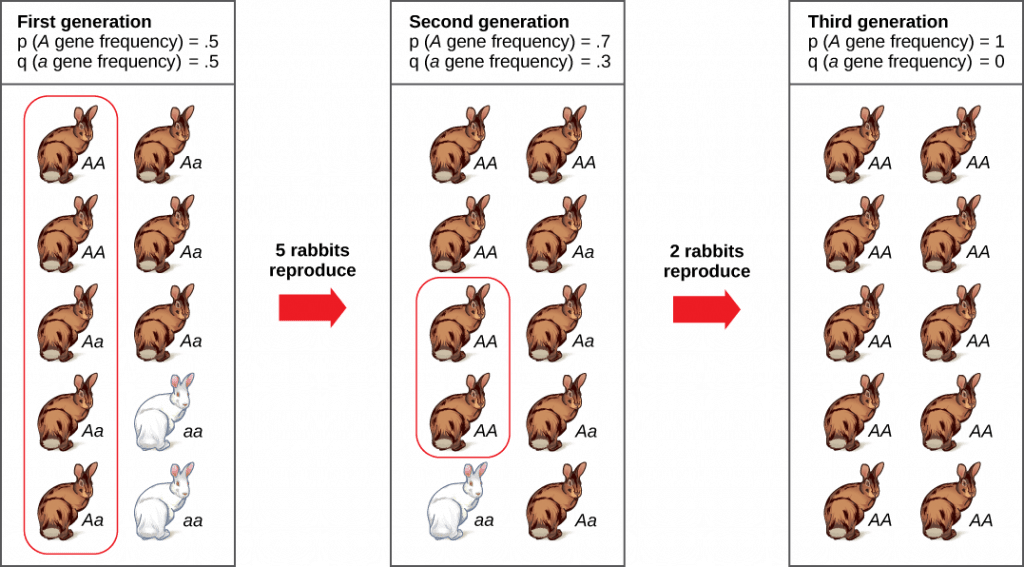
Genetic drift in a population can lead to the elimination of an allele from a population by adventure. In each generation, a random prepare of individuals reproduces to produce the next generation. The frequency of alleles in the side by side generation is equal to the frequency of alleles amid the individuals reproducing. Practise you retrieve genetic drift would happen more than rapidly on an island or on the mainland?
Evolution past cistron flow (migration) makes 2 different populations more similar to each other
2 different populations are oft subject to different selective pressures and genetic migrate, so they would be expected to accept different allele frequencies. When individuals from 1 population migrate into a different population, they bring those dissimilar allele frequencies with them. If enough migration and mating occurs between two populations, then the ii populations will experience changes in allele frequencies and such that their allele frequencies become similar to each other.
Non-random mating results from mate choice
Selecting a mate at random is a pretty risky idea because half of your offspring's genes come from your mate. Non-random mating is a more common approach in existent populations: remember about male birds existence selected as mates by females who choose males for their vivid colouration or beautiful and complex birdsong. There is evidence that fish, birds, mice, and primates (including humans) select mates with unlike HLA genotypes than themselves. Nosotros humans also tend to mate more often with individuals who resemble us phenotypically (positive phenotypic assortment). Non-random mating with "like" individuals will shift the genotype frequencies in favour of homozygotes, while non-random mating with "unlike" individuals (negative phenotypic assortment) creates an over-representation of heterozygotes. These shifts tin occur without irresolute the proportion of each allele in the population, as well called the allele frequency.
Picket this Ted Ed video to review these concepts with an like shooting fish in a barrel way to retrieve them (but note that this video does not refer to genetic drift by name, merely emphasizes that changes in allele frequencies due to chance alone is more likely to occur in small populations):
Source: https://bioprinciples.biosci.gatech.edu/module-1-evolution/neutral-mechanisms-of-evolution/
0 Response to "Evidence for Evolution Purpose to Review the Concepts Worksheet"
Post a Comment