Baby Monkey Private Eye by Brian Selznick Review
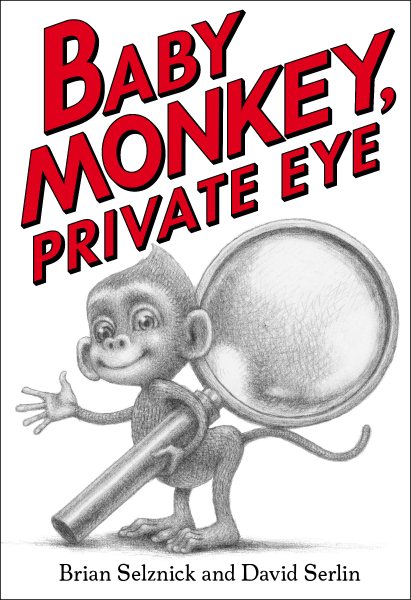 Baby Monkey, Private Eye
By Brian Selznick and David Serlin
Illustrated by Brian Selznick
Scholastic Press
$xvi.99
ISBN: 978-i-338-18061-9
Ages 3 and up
On shelves February 27th
Brian Selznick. Love. We've got to talk.
Now expect, information technology was all well and expert when you started getting a little crazy and shaking up notions of what an "illustrated book" actually means. Winning the Caldecott for a novel? Never been washed earlier. And the fact that Hugo Cabret and its companion novels Wonderstruck and The Marvels push every believable envelope, in terms of what a visual novel tin be, is not just noteworthy just historic. But now you're getting all slick on us. It wasn't enough to conquer the heart grade illustrated novel, eh? Now y'all're simply fudging the lines between early affiliate books and motion picture books in ways I've honestly never seen before. Baby Monkey, Private Eye is, every bit anyone looking at the cover could tell you, freakishly ambrosial. And funny. Simply it may likewise exist the most subversive little number to hitting our shelves in a very long time.
Got a criminal offence? Then who you gonna call? Forget Sam Spade and his ilk. The true brains in this town belong to Babe Monkey. He's a babe, he'south a monkey, and he'southward a crime fighting genius. With every client that crosses the threshold of his office, he has a routine in place. Examine the evidence. Take notes. Take a snack. Put on some pants (that particular function of the job is a flake on the trying side). And solve that criminal offense! Infant monkey always gets his human (slash zebra/lion/snake/mouse). Simply when his final example involves a missing baby, that'due south when things beginning getting personal.
SCROLL TO KEEP READING THIS POST
Take a seat. I demand to tell you a story. Nigh three years ago I got wrapped upwardly in a wave of hubris that almost knocked me flat. I had been suggested past an academic friend to contribute a chapter to a Routledge resource on picture books. Please acquit in mind that I have well-nigh no experience with academia in whatsoever course. Blithely I agreed and was subsequently floored when information technology became eminently articulate that I was in over my head. My assigned chapter was "Picturebooks and Illustrated Books", a distinction that I wasn't overly familiar with. It all worked out in the stop (thanks to the intervention of a friend who knew this territory better than I) and I got a crash class in the difference between an "illustrated book" and a "picture show book". Would that Baby Monkey, Individual Eye had been available when I was determining these distinctions. As it turns out, there is a very good reason that printing for this volume calls it "a winning new format". I'll break information technology downwardly for you.
 Permit us first option up our copy of the volume and just give it a good going over. Every bit you can see, it's your standard 5-1/iv Ten 7-3/4 inch sized novel. 192 pages in length. Seems pretty standard stuff. And even so from the moment you open up it up it's pretty articulate that the bulk of the volume is going to exist art rather than text. Though it contains five chapters, a Key, an Index, and a Bibliography (more on that later) the actual book is perfect for very immature readers. It is also perfect (and I cannot stress this enough) for reading ALOUD to large groups of very young readers. This realization had me pondering what information technology would have looked like if Selznick and Serlin had kept the folio count but pulled a Bolivar and made the pages picture book-sized. Certainly that would take taken much longer to create (lotta cantankerous-hatching would ensue) simply in an era when the walls between formats is a lot more fluid than in the past (thanks in large office to the aforementioned Hugo Cabret) it certainly could take been done. And nevertheless, the creators clearly wanted this to be an early on chapter book. Selznick actually got his start back in the 24-hour interval with The Houdini Box, which was early chapter fare of a different sort. And reading this book with my iii-twelvemonth-erstwhile and vi-twelvemonth-onetime (who both loved information technology as) this book may indeed exist 1 of those pan-age level titles that transcend audience. Doggone it.
Why practice both of my small-scale children beloved this volume so much? Considering information technology's a gut-buster, frankly. Funny? Sister, you don't know the half of it. The very opening of the book sets the stage for hilarity. You lot open information technology up and are accosted past an oversized call to "WAIT!" It then challenges you with the question "Who is Infant Monkey?" The reply? "He is a babe." Page plough. "He is a monkey". Folio turn. "He has a job to practise." That's when you see his detective agency. At present as whatsoever adept children'due south book writer knows, when writing a funny book for children, ideally you should direct some humor at the kids and some at the adult readers. Go too far in the children'south direction and y'all go Walter the Farting Dog. Go too far in the adult management and you go some crappy Dreamworks movie that's more of a prolonged wink than a film. In this, Serlin and Selznick detect the perfect sweet spot. For the adults there's a kind of seek-and-discover element to Baby Monkey'due south ever irresolute function. For kids, in that location's the fact that baby monkey cannot hands put on his own pants. Pants are, past their nature, hilarious. I remember it has something to do with the word itself. Pants. And while about jokes work best when y'all're operating under the Rule of Threes, the choice to give this book five chapters (which involves four pant-struggling sequences) is bold. Surely there was a temptation somewhere in the process to limit the chapters to three. I respect the fact that information technology's an unwieldy five instead. Gives the jokes more time to percolate.
 Monkeys should, past all rights, be classic picture book staples. With that in mind, I ask you lot this: Who is the most famous monkey in the whole of children'south literature? If you said Curious George I'1000 gonna whip out the old "Curious George is actually an ape" line and we'll take at it. But beyond George there are shockingly few famous kidlit monkeys to choose betwixt. This is particularly strange considering monkeys should potentially fill up all the requirements of children's book illustration. They are small, like man children, and cute, like human children. They are, in fact, the perfect stand up-ins. Selznick, for his function, has gone and gotten cute on us. His infant monkey is remarkably tiny. Do you remember that erstwhile Disney-drawn explanation of "The Cute Character" where the ratio of the head to trunk, ears to head, legs to feet, etc. are explained? Well, Selznick clearly knows his stuff. Baby monkey's proportions are carefully calibrated for maximum cuteness, as are his facial expressions, and body language. This is part of the reason the book works likewise equally it does with the youngest of readers. Who wouldn't honey that guy?
The art is indicative of Selznick's trademark graphite, with one notable difference. Color! That's correct, infant, there's at least ane atypical jolt of color making itself known in each chapter. I had just causeless that the red of the missing jewels / pizza / clown nose / etc. was the aforementioned as the cherry on the embrace of the book, merely this does not announced to be the instance. While the red of the letters on the cover are deep, the jewels / pizza / nose have this boggling tint to them. Maybe merely a hint of orangish? I couldn't say, but whatever it is it simply pops off the page. I recall longingly of what this volume could accept been had the author written information technology in a movie book format. So I become ahold of myself again and appreciate it for what it is.
I mentioned earlier that in writing a volume for children that'southward funny, an author has to walk a fine line between humor for kid readers and sense of humour for adult readers. In the case of Babe Monkey, though, this applies to far more than the jokes. In his art, Selznick takes care to hide in plain site multiple references to whatever case it is that Baby Monkey is about to solve. His office earlier the opera singer comes in is outfitted with portraits of Maria Callas and Marian Anderson. A bust of Mozart overseas Infant Monkey's notation taking. There's even a reference to that erstwhile Marx Brother classic (my personal favorite) A Nighttime at the Opera. With each case the décor changes. Don't think for a moment that I'm proficient at spotting all these references, though. While I got the poster for the 1980 production of Barnum and recognized the image from A Trip to the Moon (a scrap of an homage to Hugo Cabret in its way) I had to rely heavily on Selznick's "Key to Baby Monkey'southward Role" at the dorsum of the volume. There you will observe all the hidden references laid out before you. It's really dainty, really. Few artists have the time to let their readers in on their jokes. But the volume's most subtle jokes for adults are also the nearly superfluous (and, consequently, the almost charming). Later on the aforementioned "Key" you'll find an Index and Bibliography that honestly have no reason at all to be there. The Alphabetize may be worth it entirely for the entry on "Wainscoting" (Warning: it's intense). The Bibliography, all the same, is a carefully crafted labor of lovable nonsense. It is filled from guggle to zatch with nonsense books. From a 1997 edition of Animals Who Look Like They Have No Noses (2nd edition, if we're going to be specific) to Moshe Moshi'south Famous Babies I Have Known the faux titles, authors, and presses abound. Honestly, but read information technology for the authors' names. Barbara Bathtowel. Luis Gergle. Herbert Hobbypocket. I could become on all day.
I wonder if at that place'south a moment where a children's book creator peaks so crosses over to a whole new level. Sendak sort of did it, the result being that he traded his mortality for some truly birdbrained works for kids. Selznick is traveling on a Sendakian grade, but forth the way he'southward never lost his penchant for kid-friendly fare. Credit collaborator David Serlin (who'southward getting the short end of the stick in this review) or credit is unequivocal love for the audience (a weapon Sendak never had in his own back pocket). For all its seeming simplicity, Baby Monkey packs a wallop. It challenges what an early chapter book can be, information technology'southward the funniest fare you lot might read this year, information technology's beautiful to look at, and there'southward plenty to please pocket-sized children and grown adults alike. Taken as a whole, the Serlin/Selznick duo is a force to be reckoned with. Will we run across more than Baby Monkey in the future? I cannot know the respond. All I tin can promise is that these guys pair up frequently. I like where all this is headed.
On shelves Feb 27th.
Source: Galley sent from publisher for review.
Interviews:

Shelf Awareness sabbatum downwardly with the creators of this book for a bit of a tête-à-tête. You tin can find the total text here.
Filed nether: Best Books, Best Books of 2018, Reviews, Reviews 2018
Source: https://afuse8production.slj.com/2018/01/11/review-of-the-day-baby-monkey-private-eye-by-brian-selznick-and-david-serlin/
0 Response to "Baby Monkey Private Eye by Brian Selznick Review"
Post a Comment