How Are You to Know What Size Pool Filter to Install
Picking the Best Filter Size for Your Pool
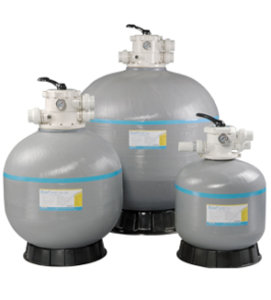
I've never understood why people buy the biggest pump they can afford, and then become small on the pool filter. I telephone call information technology the "V-eight mentality." They want the biggest engine, in the smallest motorcar.
To save you time in your valuable day, I'll requite you the moral of the story upfront. The principal point of this post is to"Go Big."
Choosing a larger pool filter makes sense, and it has many benefits:
- Longer filter cycles, or time between backwashing
- Less featherbed of fine particles
- Greater filtration of the water
- Faster cleanup of water problems
- Longer-lasting filter media
Sizes of Residential Pool Filters
Filters are commonly sized past the foursquare footage of surface expanse. Information technology makes sense: The more square feet of filter media you take, the better the filter performance will be. But it gets tricky when you try to compare the 3 unlike types of pool filters to each other.
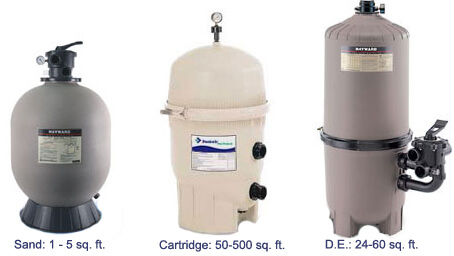 That's because they all trap clay and debris in unlike ways — they're like apples and oranges!
Don't let this confuse you, though. Within each filter blazon, at that place are typically four or five sizes.
Of these sizes, the smallest are suitable for aboveground pools, the mid-range ones can be used for small pools around 15,000 gallons, and the big filters work best for pools above 25,000 gallons.
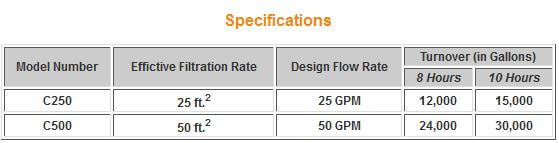
To add to the confusion are the manufacturer's listed turnover rates for their pool filters. These are normally listed on production information pages, and they show the maximum menses rates for the filters.
This snippet beneath, from our Hayward Star-Clear filter page, seems to suggest that a 25-square-foot filter can accept care of a 12,000-gallon pool, and I can tell y'all that is not the case. Non fifty-fifty close.
Sand Filters
For sand filters on in-basis pools, I like to use a 30-inch tank diameter, which has a four.9 sq. ft. filter surface area and holds 600 pounds of sand. For small pools (under 20,000 gallons), I might suggest the adjacent size down (24″ tank) if the upkeep is tight. Simply never go smaller than this for an in-footing pool.
Cartridge Filters
I have a dominion of thumb for cartridge pool filters: 100 sq. ft. of filter surface area per 10,000 gallons of pool water, equally a minimum. I like to see the 400 sq. ft. models on in-ground pools higher up 25,000 gallons. These can go an entire season without cleaning in most cases.
DE Filters
Because diatomaceous earth filters offer the most superior type of filtration, people tend to go pocket-sized and buy a 24 or 36 sq. ft. DE filter. Ugh … no, GO BIG! Don't use anything below a 48 sq. ft. filter, and if your pool is over 25,000 gallons, go with the large pick (the lx sq. ft. filter).
For the average in-ground pool, if money is available, purchase a large DE filter and be done with it. If your budget is squeezed thin this year, purchase the 30″ sand filter.
Pump Size to Filter Size
With a big pool filter, at that place'southward no worry virtually the pump being also large for the filter. Likewise, don't worry if your pump seems undersized for a larger pool filter — this is rarely the case. When the pump is besides large, however, information technology tin hateful all sorts of trouble. Clay tin exist pushed through the filter, internals can become crushed or cracked, and high force per unit area makes for a boring, inefficient and potentially hazardous situation.
Filter Size to Pool Size
Another rule of thumb I have for pool filter size is to look at the swimming puddle size in gallons. If you've never calculated this before, take some measurements. The formula isLength x Width x Average Depth x vii.5, for rectangular pools.For oval pools, change the multiplier from 7.five to five.ix.
NSF Standard fifty
Filter manufacturers size all three systems in accord with the National Sanitation Foundation (NSF) Standard 50 "Circulation System Components for Swimming Puddle."
Loftier-rate sand:Max flow rate 25 GPM per foursquare foot of surface surface area, unremarkably sized betwixt 15 and 20 GPM per sq. ft. A minimum period rate of 11 GPM per sq. ft. is required to use the torturous path filtration of depth type filter media. Catamenia rates over 25 GPM can lead to channeling.
Diatomaceous Globe (DE):Max catamenia rate 2.v GPM per square human foot of surface area, unremarkably sized at 2 GPM per sq. ft. Proper menstruation charge per unit and pressure are essential to clinch a uniform cake formation on the support grids.
Cartridge:Max period charge per unit 1 GPM per square foot of area; tin can exist sized between 0.25 GPM and i GPM per sq. ft.
Here's some pool filter size recommendations past type. Lucifer your pool size in gallons (or less) with the filter model number. And, don't be afraid to go one size bigger!

You can find dozens of swimming pool filters at InTheSwim.com
Source: https://blog.intheswim.com/how-to-size-a-pool-filter/
0 Response to "How Are You to Know What Size Pool Filter to Install"
Post a Comment